
What Tater is
The same match is priced in many places at once. Sportsbooks price it. Betting exchanges price it. Prediction markets like Kalshi and Polymarket price it. Each one shows you exactly one number: its own. None of them will tell you when a rival has a better price, because every venue's storefront exists to sell its own book.
Tater is not a venue. We hold no funds, take no positions, and sell no bets. We are the window: one screen that shows what all of those markets think about the same outcome, where they agree, where they split, and, most importantly, which one is actually offering you the best deal. When you decide to act, we route you to that venue. That is the entire model, and it only works because we have no side.
The two numbers: believe vs pay
Every outcome on Tater carries two numbers, and the gap between them is the most useful thing on the page.
The believe number is our estimate of what the market as a whole thinks the true probability is. To build it we take sportsbook prices and strip out their built-in margin (a process called de-vigging), blend them with prediction-market prices, and land on one comparable percentage. This is the fairest available answer to the question "how likely is this, really?"
The pay number is what a dollar of payout would actually cost you at a specific venue, after everything that venue charges. This is where it gets interesting, because different kinds of venues charge you in completely different ways, and most of them do not show it on the price tag.
How a sportsbook charges you
A sportsbook builds its fee directly into the odds. If two outcomes were truly 50/50, a fair price would be +100 on each side. A book will instead quote something like -110 on both. That difference is the vig, and it means the implied probabilities of all the outcomes add up to more than 100 percent. The overage is the book's margin.
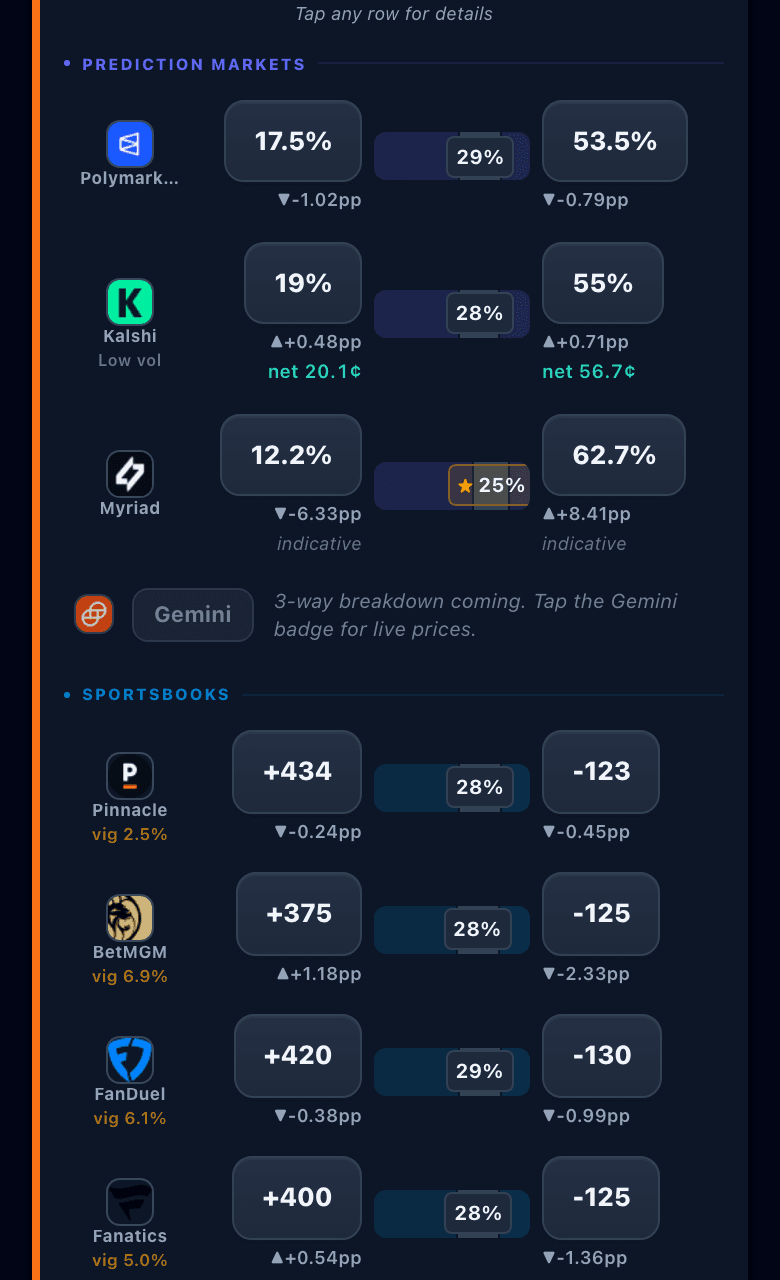
The important consequence: a sportsbook quote is the only all-in price on the board. What you see is exactly what you pay. There is no separate fee at the till. So when Tater compares venues, book prices pass through untouched: their teal line reads "all-in" with the true cost, and a small chip on each book's row shows the vig itself. On a recent World Cup quarterfinal, Pinnacle priced the match with a 2.5 percent vig while another major book priced the same match at 6.9 percent. Same game, same day, nearly triple the hidden charge.
One subtlety worth knowing, because careful readers spot it: the vig is not spread evenly across the outcomes. De-vigging shrinks each outcome by a share of its own size, so the favorite carries most of the vig in point terms. On that same quarterfinal, Pinnacle's 2.5 percent margin cost the 55.6-cent favorite about 1.4 points of probability (opinion 54.2 percent) while the 18-cent longshot gave up only about 0.4 (which rounding can hide entirely). This mirrors what we found on prediction-market fees: whatever the venue type, the hidden cost concentrates on the favorite.
How exchanges and prediction markets charge you
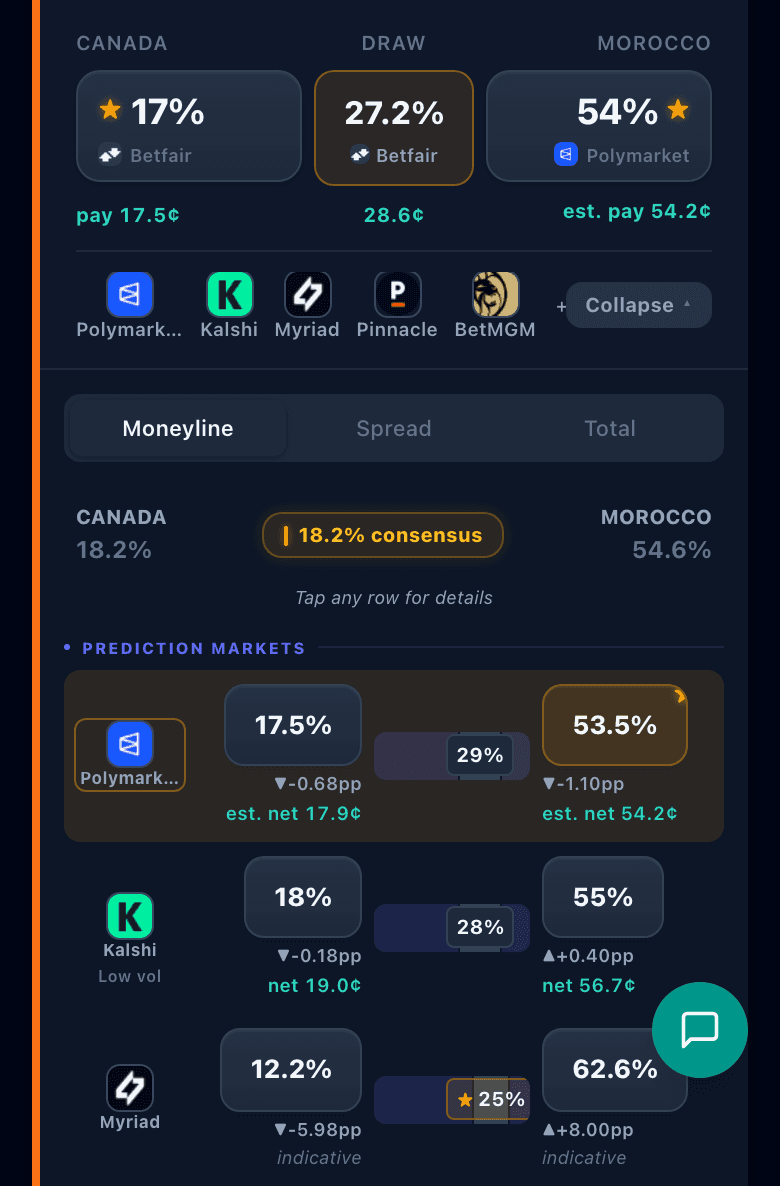
Prediction markets look cleaner at first glance. A contract priced at 19 cents implies 19 percent, and the prices of all outcomes roughly add up to 100. No vig, it seems. But the venue still has to earn, and it earns at the moment you trade: Kalshi charges a trading fee on each contract, exchanges like Matchbook take a commission on your winnings, and on any order book you also cross a spread between buyers and sellers. The price tag looks fair. The receipt is not the price tag.
So on Tater, every venue row carries the teal pay line. On prediction markets it reads "net" (or "est. net" where a component like spread is estimated): the displayed price plus that venue's real trading cost — a Kalshi contract shown at 19 cents can genuinely cost you just over 20 cents. On exchanges like Betfair or Matchbook it reads "net" with the winnings commission included, which the displayed odds never show. On sportsbooks it reads "all-in", because there the quote already is the price. Where a venue has not published its fee schedule we mark the row "indicative" and keep it out of the value ranking entirely, because guessing is not comparing. One rule, every row: the percentage is the opinion, the teal line is the price.
One finding from our own research worth knowing: these fees are usually a formula that peaks near 50/50 and, measured as effective margin, they hit heavy favorites hardest. Backing a strong favorite on a prediction market can quietly cost more in fees than the same position at a sharp sportsbook costs in vig. The venues marketed as fee-free are often most expensive exactly where casual bettors love to bet. Nobody puts that on a billboard. We put it on every card.
The star, and when it flips
The gold star on each outcome marks the best net payout: the venue where a dollar of payout costs you least after every fee we can model. Not the biggest number on the screen. The cheapest true claim on the same outcome.
Most of the time the raw comparison and the net comparison agree. But roughly one time in ten among close prices, doing the fee math changes the winner: the venue that looked best before costs turns out not to be once fees are counted. When that happens the card says so explicitly, so you can see both the naive answer and the honest one. That flip is the whole reason this layer exists.
Choose how you read the odds
Odds are one idea written in four languages. A 27.4 percent chance, decimal odds of 3.65, American odds of +265 and a fraction of 8/3 are the same statement. People are fluent in the notation they grew up on, and misreading a price you are not fluent in is one of the most common ways bettors lose money without ever making a bad judgment. So Tater lets you pick your language, everywhere: the format chip next to "The board" on the World Cup page, and the settings control in the feed. One tap, and every card follows.
The formats, and what each is really telling you:
- Auto : each venue in its native tongue. Prediction markets as percentages, sportsbooks as American odds. Closest to what you would see on the venues themselves.
- Probability : everything as a fair percentage, with book prices de-vigged first. This is the believe layer: the cleanest way to compare opinions across venue types on one scale.
- Decimal : your total payout per $1 staked. The simplest math and the easiest format for spotting the best payout at a glance.
- American : the US convention. Minus numbers are what you stake to win $100 on a favorite; plus numbers are what $100 wins you on an underdog.
- Fractional : the UK racing tradition. 8/3 means 8 profit for every 3 staked.
One thing never changes with the format: the star and the value math. Probability mode shows the market's honest opinion; decimal, American and fractional show the payout you are buying. Whichever language you read in, the fee math underneath is identical, and the star sits on the same venue. Pick the format you think in, and the card meets you there.
A worked example, because this is the single easiest thing to misread: suppose a Betfair row shows 17.5 percent in Probability mode while the teal line under the star says pay 18.8 cents. The 17.5 is Betfair's opinion: the fair probability once its margin is stripped out. It is never the price. The price is always the pay line, and for an exchange like Betfair that line already includes the commission charged on your winnings (5 percent base at Betfair, 2 percent at Matchbook), which the displayed odds do not show. Opinion tells you whether a venue agrees with the market. The pay line tells you what the claim costs. The star has already compared the pay lines for you.
Reading a card in ten seconds
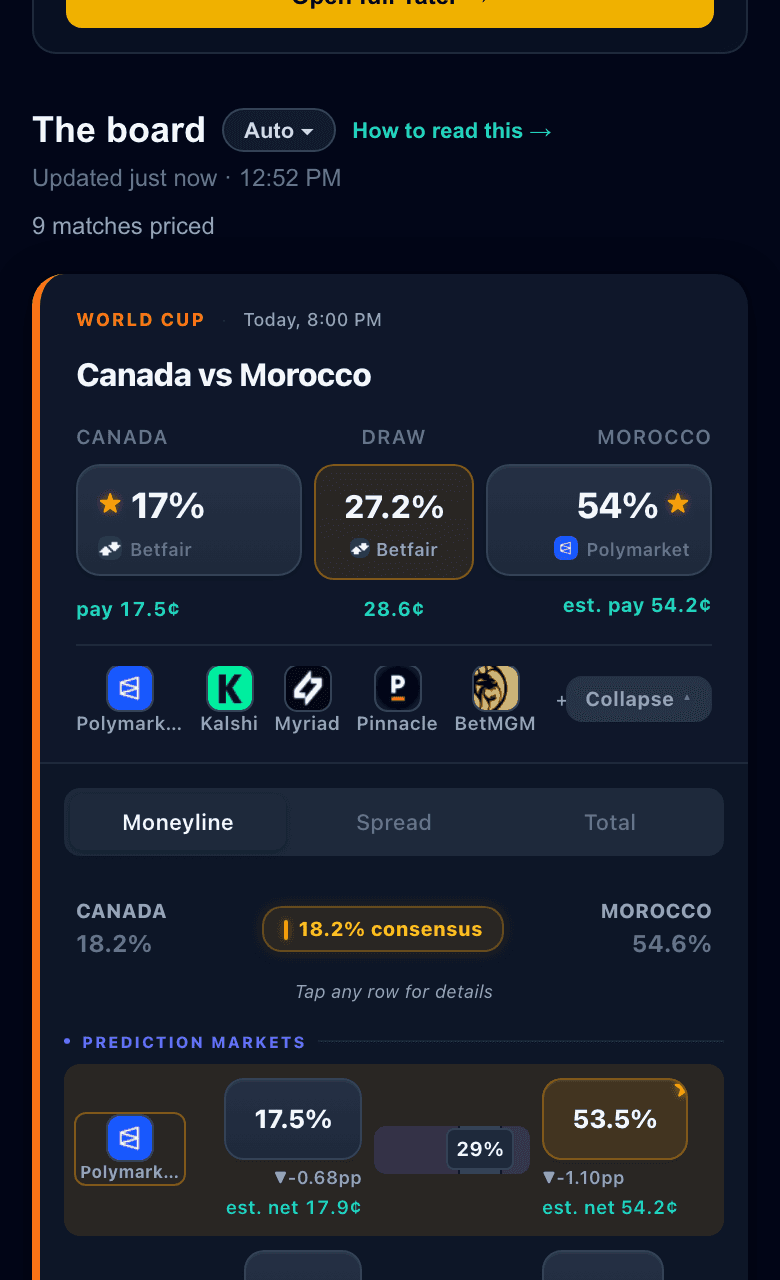
Reading order, top to bottom: the percentages are the belief. The teal line under each is the pay. The star is where to act if you agree with the number. If the belief and the pay sit close together, the market is pricing that outcome tightly and fairly. If they sit apart, someone in the chain is charging you for the trip, and the card shows you exactly who and how much.
Tap Compare and the card opens into the full ledger: every prediction market with its net line, every sportsbook with its vig chip, and each venue's distance from the consensus. One tap more routes you to the venue itself.
Where value actually lives
Here is the honest core of it. Markets are efficient enough that genuine disagreement about probability rarely lasts long. What never goes away is the difference in what venues charge: vig structures, fee formulas and spreads differ permanently, so the cheapest place to back the same outcome keeps changing with price, probability and venue. A longshot might be cheapest on a prediction market, where the fee formula barely touches the tails. A heavy favorite is often cheapest at a low-vig book. A mid-price outcome can flip either way on a given afternoon.
There is no single right venue. There is a right venue per outcome, per price, per moment, and that answer moves. Surfacing it every time, with no stake in the answer, is Tater's job. Through the rest of the World Cup, every knockout match story we publish carries a "where the value is" read alongside the consensus: not just what the market thinks, but where backing that opinion costs least, and why it costs least there.
Our promise
We are not a venue and we never will be. We do not hold funds, execute bets, or give trading advice. Every number on a card traces to a live market or a published fee schedule; where we estimate, we label the estimate; where we cannot verify a venue's costs, we say "indicative" and exclude it from the ranking rather than guess. When the fee math is boring and changes nothing, the card says nothing. When it changes the answer, the card says so. That is the deal: the whole board, both numbers, no side.
Subscribe to Tater Research
Get future publications in your inbox. No spam.
Small glossary
Vig : the margin a sportsbook builds into its odds. Visible on Tater as a percentage chip on each book row.
De-vig : removing that margin to recover the book's honest probability estimate. Tater's consensus uses de-vigged book prices.
All-in / net price : what a dollar of payout truly costs at a venue after its fees, commission or spread. For sportsbooks the quote already is the all-in price.
Consensus : Tater's blended estimate of the true probability across prediction markets and de-vigged books.
Dispersion : the permanent differences in what venues charge for the same claim. Belief disagreements fade fast; dispersion is forever, and it is where value lives.
Fee models used on the cards: Kalshi and Gemini trading-fee formula per their published schedules; Polymarket category rates labeled as estimates; Matchbook commission on winnings; sportsbook quotes passed through unmodified. Venues without published schedules are shown as indicative and excluded from best-value ranking.